Wind Power Forecasting and Fault Analysis System
Power forecasts up to 48 hours ahead from SCADA data, fault classification and predictive maintenance.
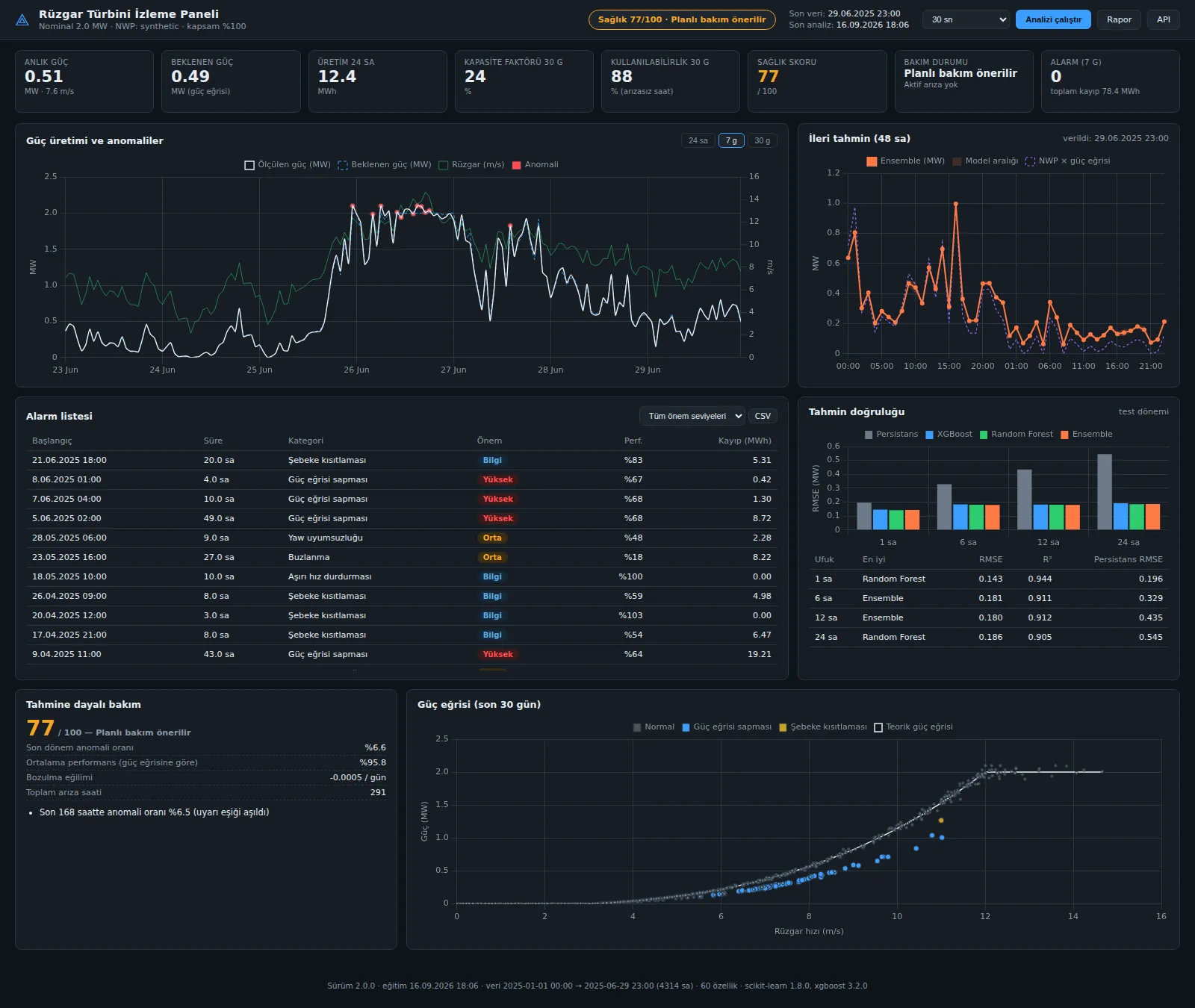
Industrial software for wind turbine operators: it cleans SCADA data, forecasts generation 1–48 hours ahead using numerical weather prediction (NWP), detects anomalies and generates maintenance decisions.
The system trains six different machine learning models (XGBoost, LightGBM, CatBoost, Random Forest, Extra Trees, HistGB) with time-ordered validation and combines them with a conformal 90% prediction interval. Through the Open-Meteo integration, weather forecasts extrapolated to hub height are used as features at the target hour. Isolation Forest-based anomaly detection and physics-based fault classification in six categories produce an alarm list and estimated generation loss (MWh) without requiring labeled data. Results are delivered through a SCADA-style web dashboard, a REST API (OpenAPI) and CSV exports; drift monitoring (PSI), a model registry and a scheduled retraining loop keep the operation running on its own. The method was tested without any customer data on ENGIE's open La Haute Borne SCADA data (4 × Senvion MM82, 2014–2015; Etalab Open Licence 2.0) with a time-ordered split: using past SCADA only and no real weather forecast, it is on par with the persistence baseline at 1 h (−0.6%), and has 3.7% lower error at 6 h and 9.3% at 24 h; the interval with a 90% target covered 83–87% on the test period (below target because of distribution shift). The unlabeled anomaly step flagged 10.6 MWh (0.23%) of below-expected output in a 4,651 MWh test period; this is a loss estimate, not a claim of detecting faults.
Highlights
- 6-model ensemble + conformal prediction interval
- Forecast horizons of 1 / 6 / 12 / 24 / 48 hours
- Fault classification in 6 categories, alarms and MWh loss estimates
- Health score and PdM decisions ranked by urgency
- Drift monitoring and automated retraining
- Docker, CI and 129 automated tests
Technology
- Python
- FastAPI
- XGBoost / LightGBM / CatBoost
- Open-Meteo NWP
- Docker
- Chart.js
Links
- 9.3%
- Error reduction vs. persistence at 24 h horizon — open data, time-ordered test
- 83–87%
- Measured prediction-interval coverage (target 90%) — open data
- 17,287
- Hourly plant records used in validation (ENGIE La Haute Borne)
- 129
- Automated tests
Solving a similar problem?
Next project
ZENQUOX GLP LIMS & MES →